

How to read your connection charge reconciliation
What is the connection charge?
This is the connection charge you were quoted. It is not newly calculated or changed by this document.
The reconciliation starts with your quoted charge and then explains how it is represented in the regulatory framework.
The main reconciliation relationship
In the reconciliation, you may see a formula that looks like this:
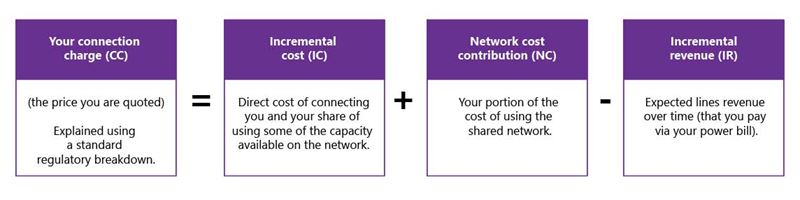
This is not how your price was set. It is a way of explaining how the following things are shown together for transparency:
- The costs of connecting you
- The revenue expected from your connection over time
- Your contribution to shared network costs, including capacity
Each of these terms is explained below.
Incremental Cost (IC) – What it costs to connect you
Incremental cost represents the direct costs incurred to provide your connection, based on the minimum scheme. It is the regulated way of describing what it costs to connect you and support your demand on the electricity network.
It can include:
Extension Cost (EC)
The cost of building the physical assets needed to connect you (for example, lines, cables or transformers), based on the lowest-cost technically acceptable solution.
Customer-Selected Enhancements (CSE)
Any additional features you chose beyond the minimum scheme (for example, higher capacity or redundancy). If you didn’t request enhancements, this will be zero.
Network Capacity Cost (NCC)
Your share of the cost of adding capacity to the wider network so it can support your connection. This reflects that electricity networks are shared systems.
Incremental Transmission Cost (ITC)
Any additional costs associated with the national transmission system (if applicable).
Localised Historical Cost Recovery (LHCR)
In limited cases, an adjustment reflecting past network investment in a specific location.
Operating Cost Loading (OCL)
An allowance for additional operating costs. This typically applies only to certain non-standard connections.
Incremental Revenue (IR) – Revenue expected over time
Incremental revenue represents the network revenue we expect to receive from your connection over time, including:
Incremental Distribution Revenue (IDR)
Revenue from distribution charges you are expected to pay as part of your power bill.
Incremental Transmission Revenue (ITR)
Revenue associated with national transmission charges (where relevant).
Because this revenue is received over many years, it is shown using Net Present Value (NPV) — meaning future revenue is converted into a ’today value’ so it can be compared fairly with upfront costs. [Please refer to the NPV explanations below for more on NPV calculations.]
This does not mean you are being charged revenue. It is an explanatory comparison only.
Network Cost Contribution (NC) – Your contribution to shared network costs
This term reflects how your connection contributes to the cost of the wider shared network.
It helps show that some network assets are shared by many customers, and how costs are spread fairly over time.
Why does my connection reconciliation include an ‘revenue’/‘NPV’ calculation?
When you connect to the electricity network, you usually pay an upfront connection charge, and pay ongoing network charges as part of your power bill over many years.
The reconciliation compares these together to see whether your connection is paying its fair share over time.
To do that, we use something called Net Present Value (NPV, or PV).
What does 'Net Present Value' mean?
Money received in the future is worth less than money received today. For example, $1,000 today is worth more than $1,000 spread out over the next 10–20 years.
An NPV calculation adjusts future amounts into today’s value so they can be compared fairly with upfront costs.
Why is NPV used in connection pricing?
When you connect we incur costs now (to build and upgrade the network) and we receive revenue from you over time through ongoing network charges.
The NPV calculation helps answer this question: If we look at everything over time, is the connection broadly covering its fair share of costs?
It brings upfront costs and future network revenue into the same 'today value' terms.
The revenue tables – why are there so many numbers?
The year-by-year tables show:
- Forecast electricity usage
- Forecast network charges
- How revenue is expected to change over time
These tables are required by regulation to support transparency and comparability.
You do not need to validate or recalculate these figures. They are estimates used solely for the reconciliation disclosure.
Does this change what I pay?
No. The NPV calculation is part of a regulatory transparency requirement. It:
- Does not automatically change your quote
- Does not create an additional charge
- Is not something you need to calculate yourself
It simply explains how your connection charge compares to the long-term cost of serving your connection.
Why is this helpful?
It helps ensure:
- New connections are not unfairly subsidised by existing customers
- New customers are not charged disproportionately high amounts
- Pricing is transparent and comparable across Aotearoa