

We’re seeking expressions of interest (EOI) from businesses that provide energy solutions to dairy farmers in Taranaki, or plan to do so in the next 12-18 months.
Understanding Taranaki’s changing farm energy needs
The way farms use electricity is expected to change significantly over the coming years as more farm activities are electrified.
Farm electricity demand could decrease as farmers generate their own energy, increase as more activities are electrified, or become more variable as farmers respond to changing energy markets.
We want to better understand this changing energy landscape, and how we can work with energy solution providers to deliver better outcomes for farmers and rural communities.
We’re interested in hearing from businesses providing solutions such as solar, battery energy storage systems (BESS), electric vehicle charging, heating and chilling management, or flexibility services.
Powerco is seeking expressions of interest
Through this expression of interest, we want to understand:
- What energy solution providers and farmers may need from us, such as network services, information or pricing
- What services Powerco may acquire from energy solution providers
- How respondents view three future scenarios and their expectations
You don’t need to offer a complete solution or already be active in the market to respond. Collaboration may be needed across multiple providers to meet future customer needs.
We’ve designed this to be a quick and simple expression of interest, with eight click-and-select questions and nine short-answer questions.
Shortlisted respondents will have the opportunity to take part in a further exploratory call. This expression of interest is to inform us on how our network and services should change, and to enable us to work with those bringing new services to farmers.
Click here to submit your EOI response
Click here for our Terms and Conditions
| Milestone | Date |
|---|---|
| EOI opens | 12 October 2026 |
| Online briefing | 11am 20 October 2026 |
| EOI closes | 12pm 30 October |
| Interviews (approx) | Early-to-mid November |
| Indication to primary partner(s) - preliminary | Early December |
More information on the expression of interest
This is intended to be a light-touch expression of interest (EOI) process to discover relevant value network participants for further engagement.
We plan to hold short (approximately one hour) interviews for shortlisted parties to explore opportunities and challenges in more detail.
Our intention is to select partners to participate in a co-design process at the next stage (summer/autumn 2027). This phase will explore how our services, information, pricing or other inputs meet farmer needs.
This will then lead to a market test of commercial offerings for farmers in late 2027 or 2028, with the potential to scale. Powerco does not propose to develop services, information, pricing or other offerings for farmers. Instead, we will adapt what we provide to better support the services you deliver to them.
This co-design phase may involve one or more partners working together or separately and may involve additional procurement steps. However, shortlisted respondents will be well placed to influence any next steps, including identifying and addressing gaps collectively.
In parallel with the EOI, we’re engaging farmers to:
- Share how our energy choices are changing
- Understand farmers’ opportunities and needs
- Identify the barriers that may be holding farmers back
All questions and responses must be submitted via the form on this page. If you have a query, please email future.energy@powerco.co.nz. You may also receive approved correspondence from our team member Jamie Silk from Silk Advisory.
Powerco is not looking to purchase a specific product or service (eg, to address a known constraint or investment deferral), not to fund the development or pilot of a product or service.
The planned engagement with a market test is not a pilot. It is intended to be an in-market validation of sustainable offerings that are expected to scale.
Powerco’s coordinated programme is exploring flexibility and future service options for multiple customer segments and/or specific deferral project opportunities through separate processes with dedicated teams. Information provided to each is held separately and so should be repeated if responding to multiple opportunities.
We want to learn about value network opportunities, barriers and enablers for delivering future services that benefit rural customers and where Powerco can make a difference.
We are also interested in how respondents view the future scenarios and farmer adoption pathway. We are also exploring these directly with farmers.
To support structured discussion, we have developed three potential future energy pathways for dairy farms. These are set out below and may be useful to reference in your responses.
1. Keep it on the farm
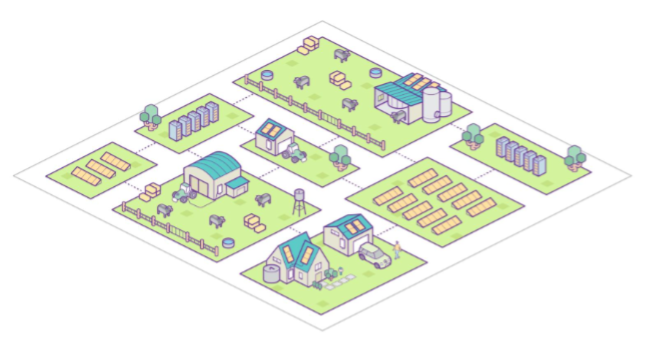
Farmers use their solar, batteries or other equipment to cut power costs and reduce reliance on power from the network. Their system is set up to make the best use of power generated on farm.
2. Farm energy users
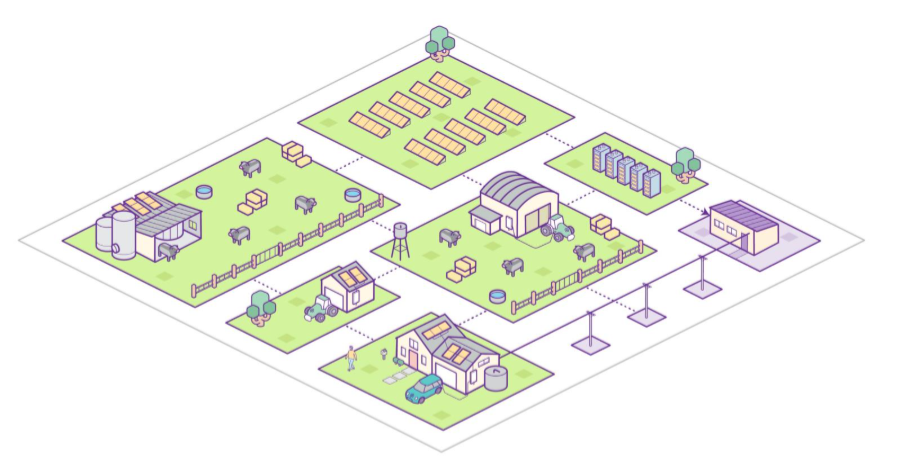
Farmers use their solar and batteries to save on their farm and to earn extra income. They let their retailer control their battery, heating, cooling, pumping or power generation to maximise what they earn.
3. Power shared locally
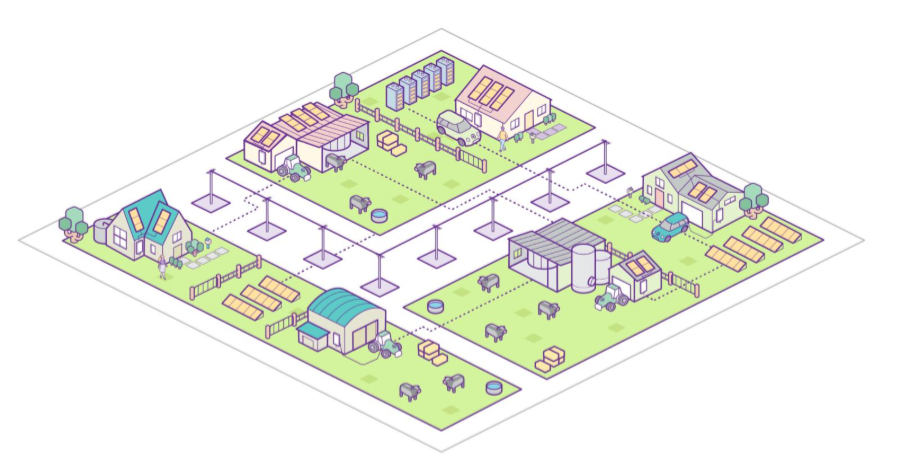
Farmers use their solar, batteries or other equipment to cut power costs and reduce reliance on power from the network. When they have surplus power, they share it locally, and they can also use power from neighbours when they have excess – a bit like a cooperative.
The following table outlines the benefits and differences between the three scenarios:
| Energy pathway | Bill savings | Earn more income | Retailer control | Simplest | Local benefit | Resilient power | Timing on returns |
|---|---|---|---|---|---|---|---|
| Keep it on the farm | ✓ | ✓ | On farm | Pays now | |||
| Farm energy earners | ✓ | ✓ | ✓ | ⚠ | On farm | A few sites pay (expected 3–5 years) | |
| Power shared locally | ✓ | ⚠ | ⚠ | ✓ | Community | Changes needed |
Key: The symbol signals there is uncertainty and will depend on how services evolve.
We define network services broadly when considering future options for better customer outcomes. This includes network services we supply, future design that may change costs or functionality, operations that may dynamically manage network or customer capacity or reliability, pricing or information, and the services we acquire (eg, flexible demand, storage or managed demand profile outcomes/information). For this EOI and our expected engagement with customer solutions and providers, we broadly categorise these across:
| Powerco ‘service’ type | 1. Different network pricing | 2. Flexibility or other capacity/energy related payments | 3. Information services and ‘system’ optimisation |
|---|---|---|---|
| Path | Price evolution | Market-led | Data/insights-led |
| Description | Powerco ‘simply’ changes the level, structure or dynamic nature of network pricing in a way that supports customer solutions that deliver more value. | Powerco pays for flexibility that supports better network and/or customer outcomes. Currently, Powerco is not aware of material load constraints that would drive payments. | Powerco supplies network or other data that enhances outcomes for farmers. For instance, this could be dynamic operating envelopes to support better use of CERS, flexible connections or something novel (eg, resiliency risk information to support switching of BESS to standby). |
The benefits we anticipate of interest include:
Network value drivers(delivering the right services at the right cost for customer outcomes)
|
Adding value to customers(offering and pricing our capabilities in the way that maximises customer outcomes for NZ Inc)
|
The following table outlines the three scenarios in more depth:
| Overview | Benefits | Fallbacks | |
|---|---|---|---|
| Keep it on the farm |
You use your solar, batteries or other equipment to cut your power costs and reduce your reliance on power from the network. Your system is set up to make the best use of power generated on farm. It’s simple and what most farmers do today. The network will lose volume, and the great resources farmers have bought will not reduce market/network costs or help resilience. The industry and our network create less value for consumers. But will this be the farmer’s default choice?
|
|
|
| Farm energy earners |
You use your solar and batteries to save on-farm and to earn extra income. You let your retailer control your battery, heating, cooling, pumping or power generation to maximise what you earn. This is the smart energy future. Our network adds new value connecting farmers new resources to markets where they are paid to help reduce price peaks and support us all in emergencies. Are they interested in earning more in exchange for some control of their assets?
|
|
|
| Power shared locally |
You use your solar, batteries or other equipment to cut your power costs and reduce your reliance on power from the network. When you have surplus power, you share it locally, and you can also use power from neighbours when they have excess, a bit like a cooperative. This is a different local energy system. Lots of PV, storage, V2G, smarts, DSO management and network automation support ‘microgrids’. Consumers value buying/selling power locally to keep money locally and for resilience. Do farmers value community resilience over farm power, or local economy over maximum on farm return?
|
|
|